Robust machine learning for environmental applications
I am a PhD candidate in Data Science at the Berliner Hochschule für Technik (BHT), supervised by Prof. Dr. Felix Bießmann in the Cognitive Algorithms Lab.
I build machine learning for environmental monitoring and evaluate it holistically: not only accuracy, but also model complexity and robustness when data are incomplete, noisy or sparse. With partners such as the Federal Institute for Geosciences and Natural Resources (BGR), I apply this to urban sewer systems, soil science and groundwater.
Forecast groundwater levels in time at monitored wells, and predict them in space where no well exists.
2025–present · with BGR
Groundwater level prediction at unmonitored locations
Can a dense monitoring network predict groundwater levels at future times and at locations without a well, and what limits it? With BGR, we benchmark temporal, spatial and coupled models for Brandenburg under one evaluation protocol. Manuscript in preparation.
Spatiotemporal modeling
Gaussian Processes
Uncertainty
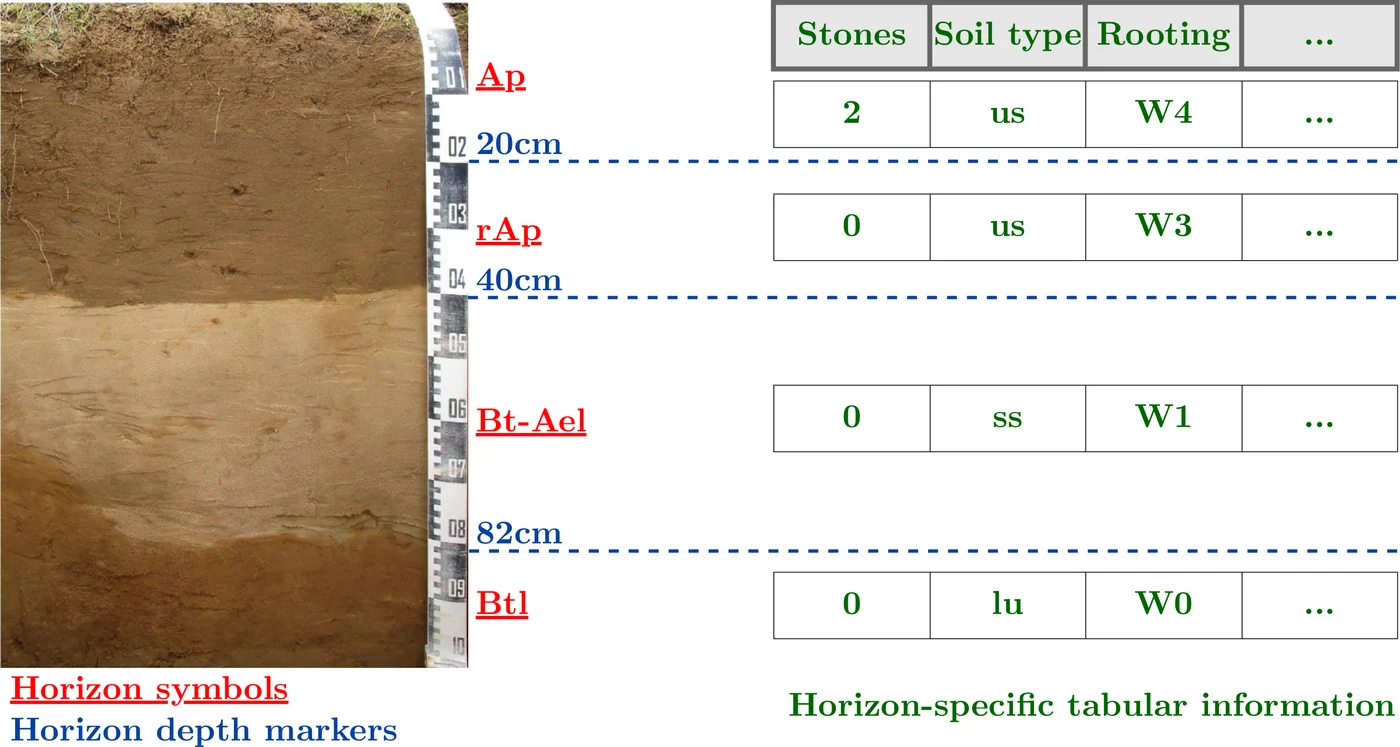
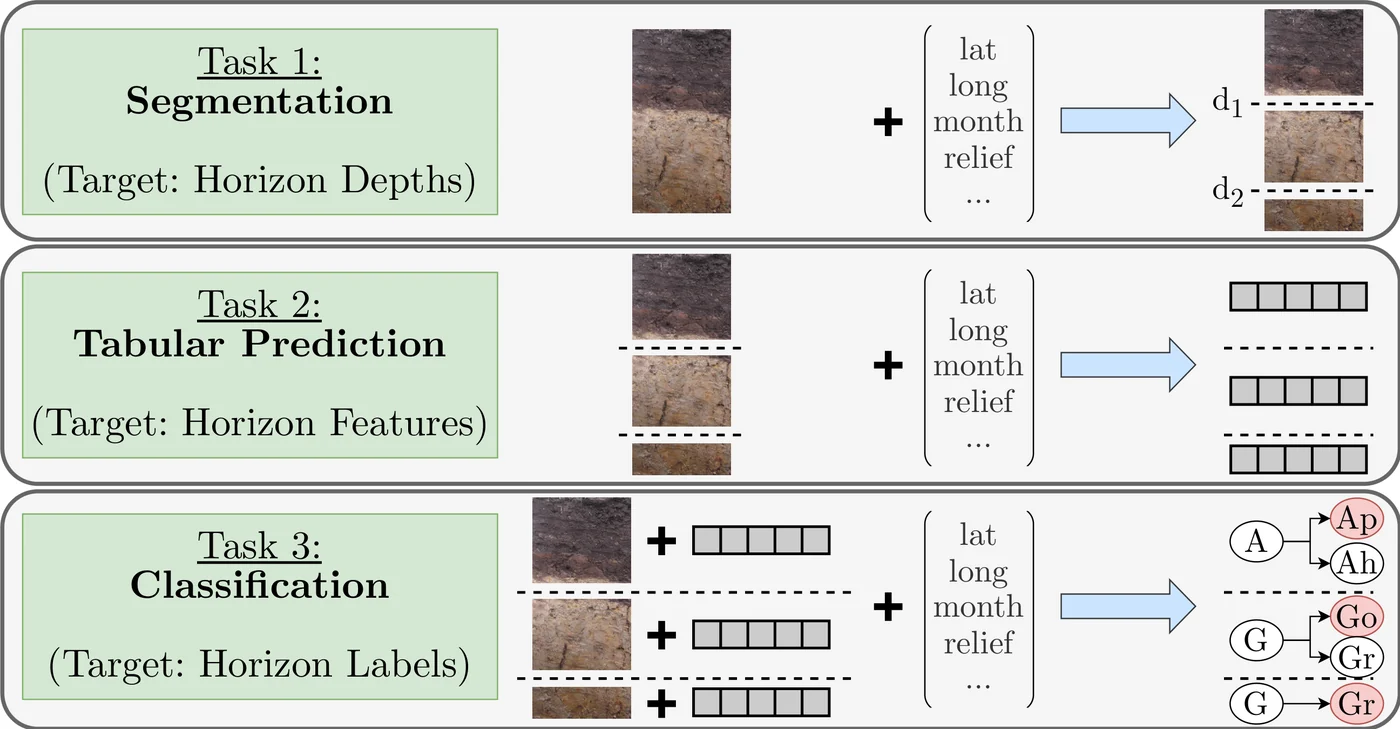
A soil profile image with horizon symbols, depth markers and horizon-specific tabular information (Singh et al., Geoderma 2026, Fig. 1).
2025–present · with BGR
SoilNet, AI-assisted soil horizon description
Describing soil horizons from profile images is slow and varies between experts. SoilNet mirrors the experts' annotation workflow, and in a user study, experts working with the SoilNet App annotated more accurately and more consistently.
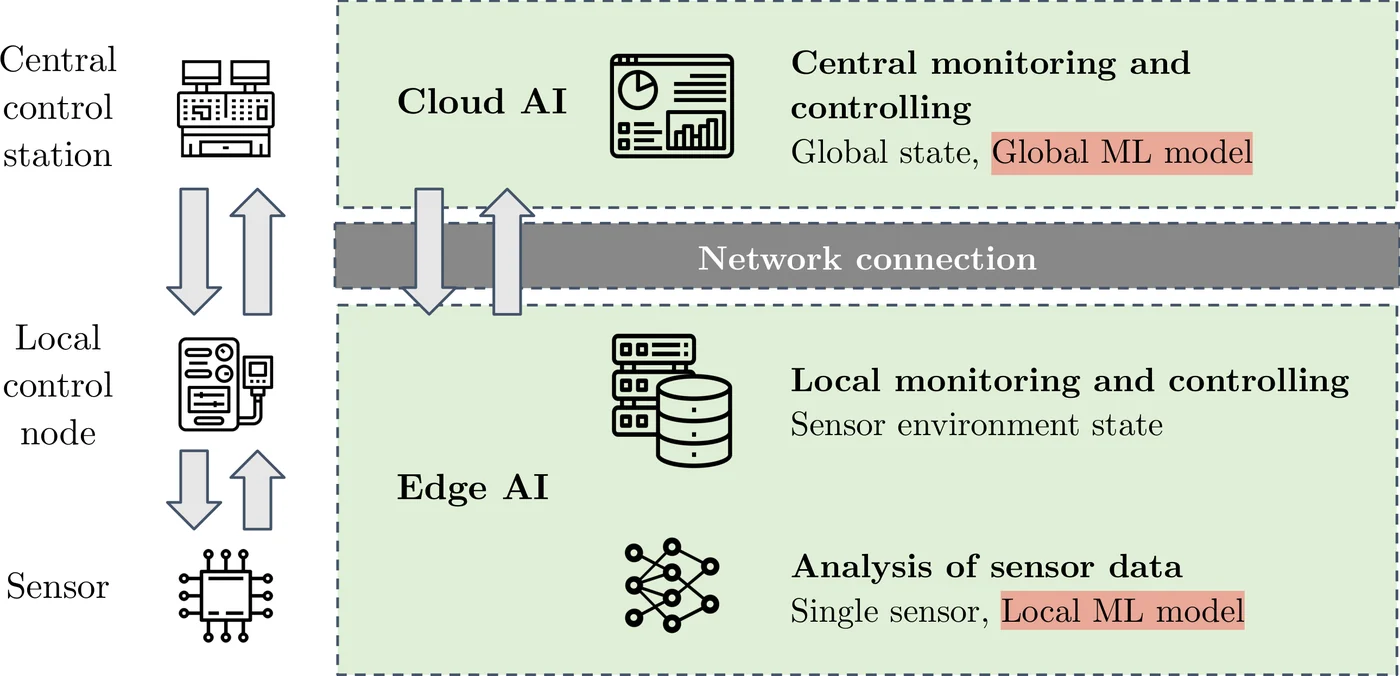
Global models in the cloud use the whole sensor network; local models on edge devices keep forecasting when the network fails.
2023–present · with University of Duisburg-Essen and partners
RIWWER, resilient forecasting for urban sewer systems
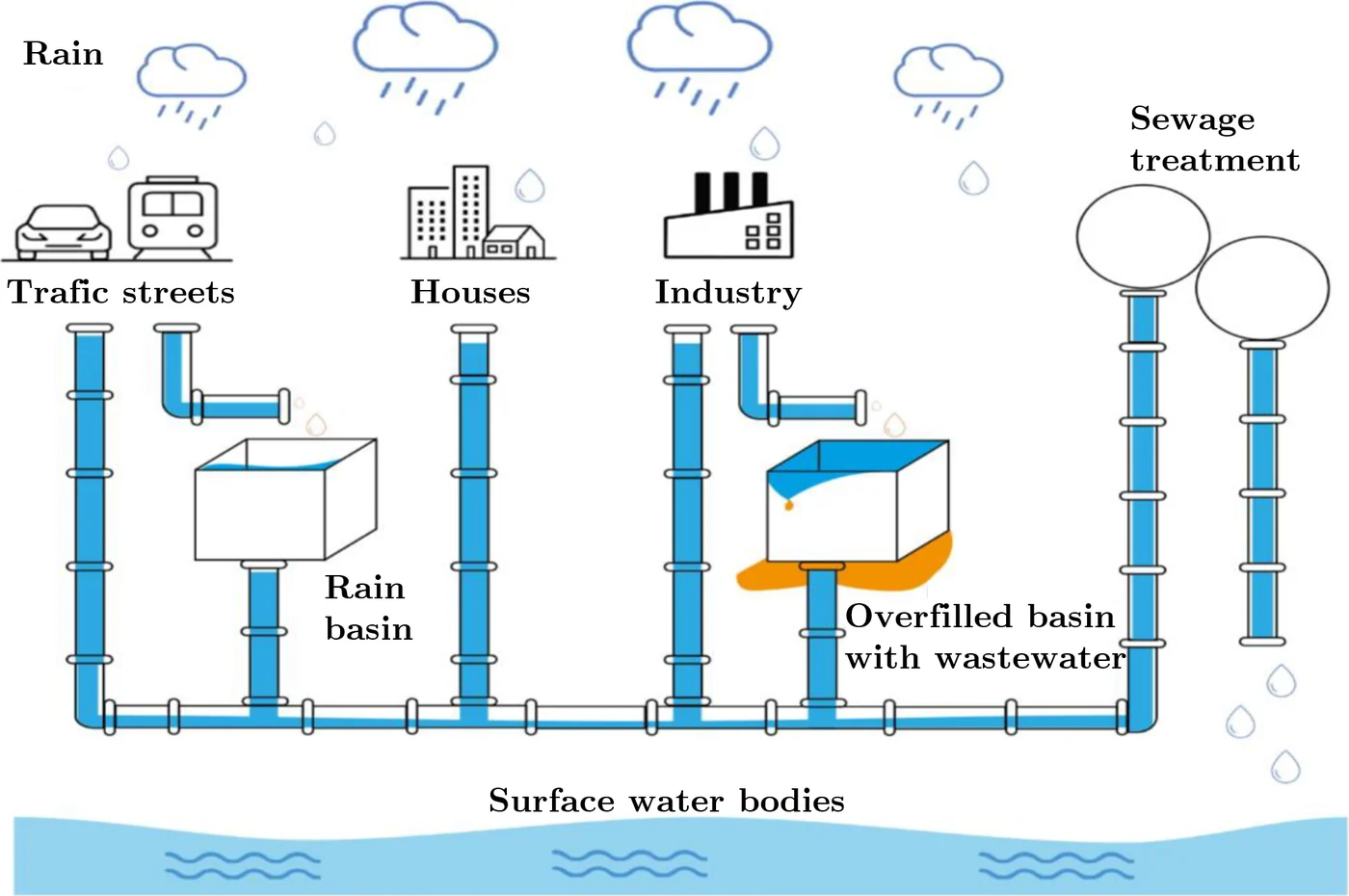
Combined sewer systems overflow during heavy rain. In the joint project RIWWER, I coordinated the AI work package: forecasting models for rain basins that stay robust to sensor failures and run both in the cloud and on embedded FPGAs at the edge.
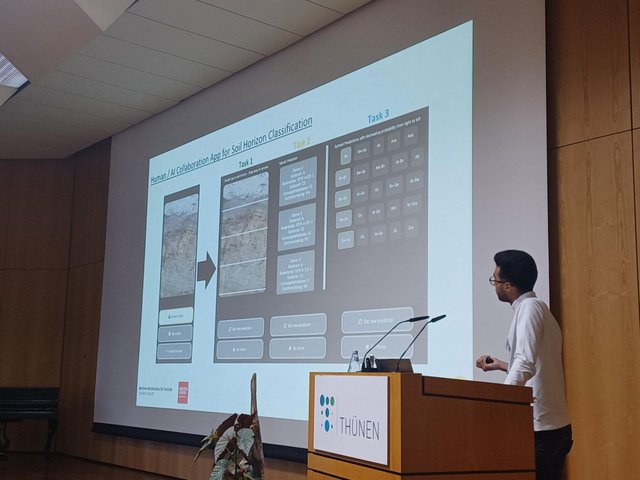
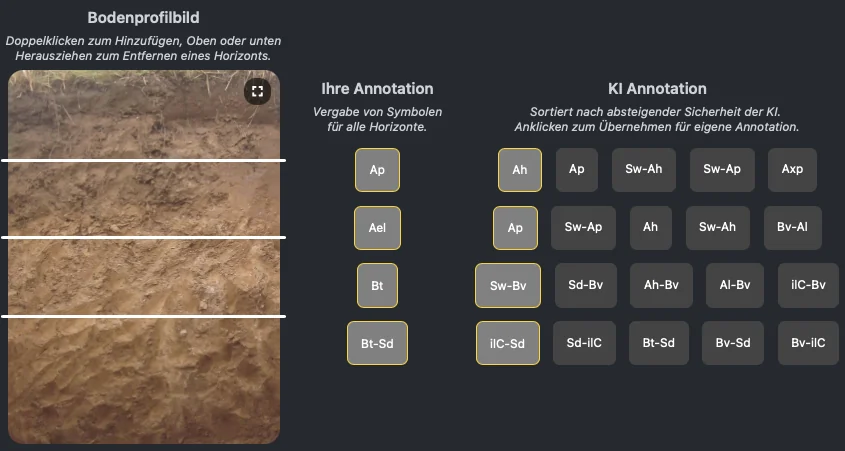
The SoilNet App: AI-suggested horizon labels, sorted by model confidence, that experts accept or correct.
ConferenceDemo TrackIJCAI-ECAI 2026
SoilNet App: AI-Assisted Expert-level Annotations of Soil Horizons
Vipin Singh, Joey Prüssing, Teodor Chiaburu, Einar Eberhardt, Sina Hesse, Stefan Broda, Frank Haußer, Felix Bießmann
Proceedings of the 35th International Joint Conference on Artificial Intelligence (IJCAI-ECAI 2026), Bremen, Germany, 2026.
A web-based demonstrator that guides experts through the tasks needed for expert-level soil horizon annotations from profile images. A user study with annotation experts shows that collaborating with the model increases expert performance and inter-annotator consistency.
@inproceedings{singh2026soilnetapp,
  author        = {Singh, Vipin and Pr{\"u}ssing, Joey and Chiaburu, Teodor and Eberhardt, Einar and Hesse, Sina and Broda, Stefan and Hau{\ss}er, Frank and Bie{\ss}mann, Felix},
  title         = {{SoilNet App: AI-Assisted Expert-level Annotations of Soil Horizons}},
  booktitle     = {Proceedings of the Thirty-Fifth International Joint Conference on Artificial Intelligence, {IJCAI-26}},
  pages         = {8518--8521},
  address       = {Bremen, Germany},
  publisher     = {International Joint Conferences on Artificial Intelligence Organization},
  year          = {2026},
  month         = aug,
  doi           = {10.24963/ijcai.2026/993}
}
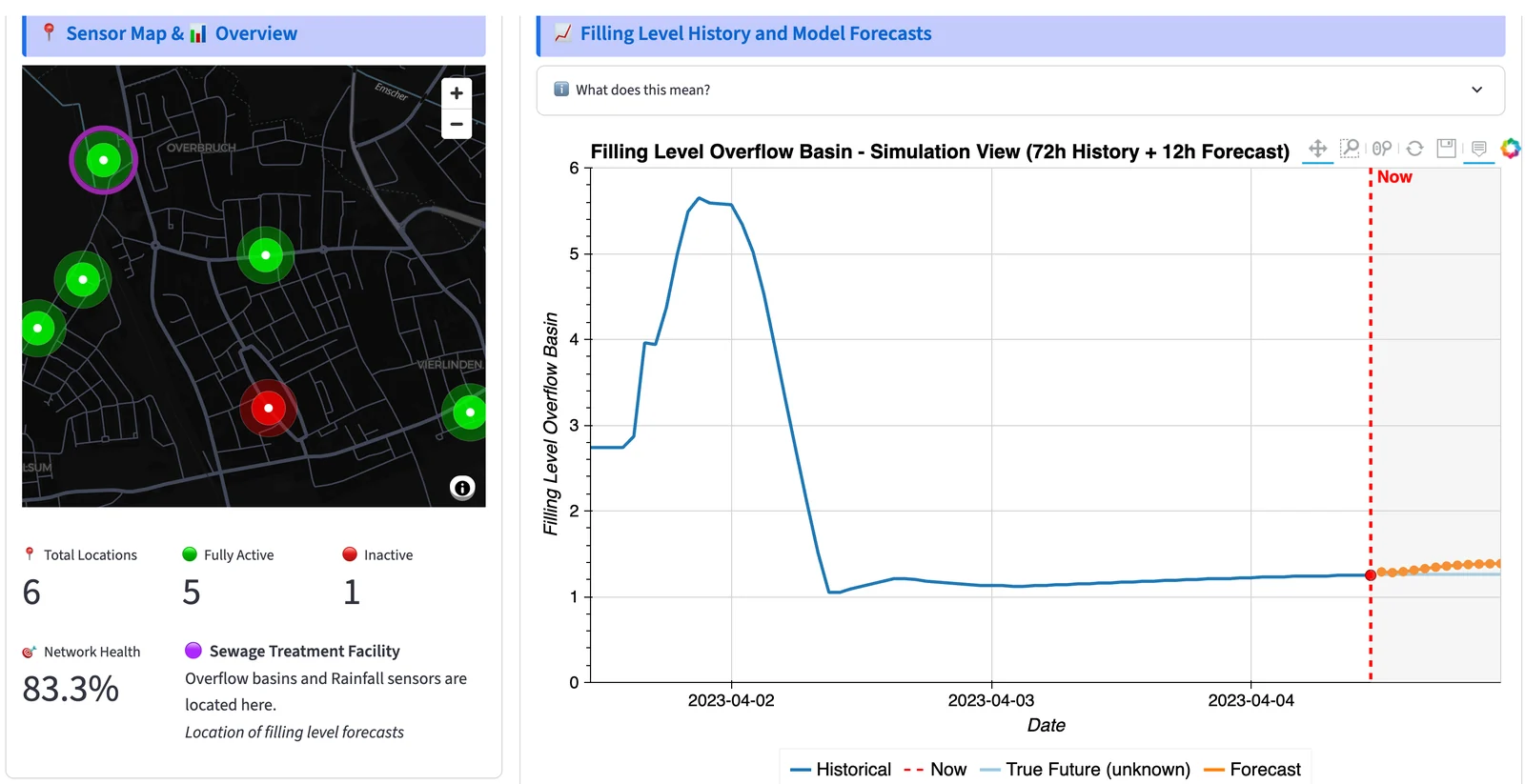
The live demo at time step 2244 (4 April 2023): sensor network map with one sensor offline, and the filling level of an overflow basin over the last 72 hours with the 12-hour forecast.
ConferenceDemo TrackIJCAI-ECAI 2026
A Resilient Solution for Sewer Overflow Monitoring Across Cloud and Edge
Vipin Singh, Tianheng Ling, Peter Ghaly, Felix Grimmeisen, Gregor Schiele, Felix Bießmann
Proceedings of the 35th International Joint Conference on Artificial Intelligence (IJCAI-ECAI 2026), Bremen, Germany, 2026.
A web-based demonstrator that integrates our deep learning forecasting methods for combined sewer overflow monitoring across cloud and edge. Its interactive dashboard stays usable during network outages, enabling timely preventive action during extreme rainfall.
@inproceedings{singh2026resilient,
  author        = {Singh, Vipin and Ling, Tianheng and Ghaly, Peter and Grimmeisen, Felix and Schiele, Gregor and Bie{\ss}mann, Felix},
  title         = {{A Resilient Solution for Sewer Overflow Monitoring Across Cloud and Edge}},
  booktitle     = {Proceedings of the Thirty-Fifth International Joint Conference on Artificial Intelligence, {IJCAI-26}},
  pages         = {8522--8525},
  address       = {Bremen, Germany},
  publisher     = {International Joint Conferences on Artificial Intelligence Organization},
  year          = {2026},
  month         = aug,
  doi           = {10.24963/ijcai.2026/994},
  eprint        = {2605.10592},
  archivePrefix = {arXiv}
}
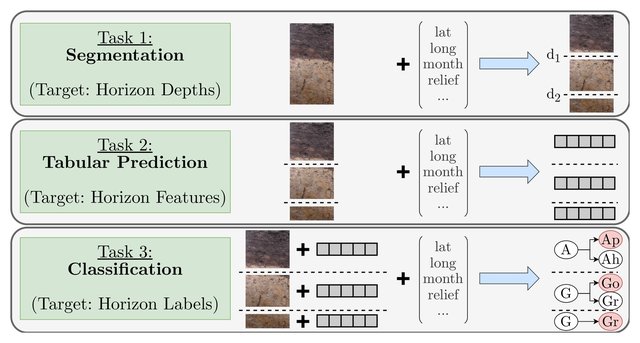
SoilNet's three tasks mirror the expert workflow: find the horizon depths, predict their features, then classify them.
JournalGeoderma
SoilNet: A multimodal multitask model for hierarchical classification of soil horizons
Vipin Singh*, Teodor Chiaburu*, Einar Eberhardt, Stefan Broda, Joey Prüssing, Frank Haußer†, Felix Bießmann†
Geoderma 466, 117684, 2026. Open access*equal contribution · †equal supervision
A multimodal multitask neural network for automatic soil horizon classification from profile images and metadata. Its grey-box design mirrors the annotation procedure used by domain experts.
@article{singh2026soilnet,
  author        = {Singh, Vipin and Chiaburu, Teodor and Eberhardt, Einar and Broda, Stefan and Pr{\"u}ssing, Joey and Hau{\ss}er, Frank and Bie{\ss}mann, Felix},
  title         = {{SoilNet: A multimodal multitask model for hierarchical classification of soil horizons}},
  journal       = {Geoderma},
  volume        = {466},
  pages         = {117684},
  publisher     = {Elsevier},
  year          = {2026},
  month         = feb,
  doi           = {10.1016/j.geoderma.2026.117684},
  eprint        = {2508.03785},
  archivePrefix = {arXiv}
}
2025
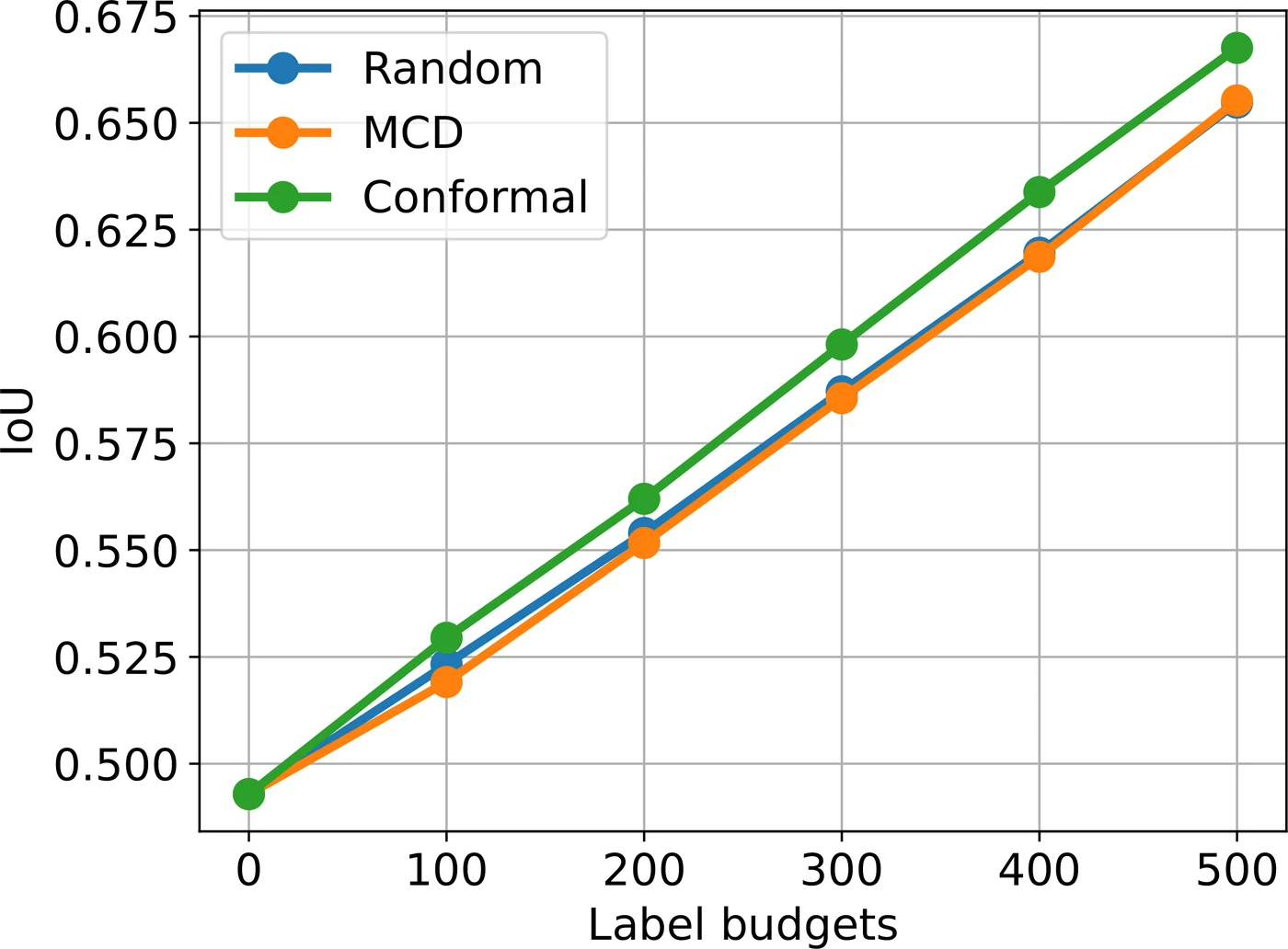
Correcting the predictions flagged by conformal intervals improves segmentation (IoU) faster than random or Monte Carlo dropout selection.
WorkshopECAI 2025 Workshop
Uncertainty-Guided Expert-AI Collaboration for Efficient Soil Horizon Annotation
Teodor Chiaburu, Vipin Singh, Frank Haußer†, Felix Bießmann†
CLEAR-AI Workshop at the European Conference on Artificial Intelligence (ECAI 2025), Bologna, Italy, 2025. †equal supervision
Applies conformal prediction to SoilNet to obtain calibrated uncertainty estimates, and shows the benefit of calibration in a simulated human-in-the-loop annotation pipeline with a limited query budget.
@inproceedings{chiaburu2025uncertainty,
  author        = {Chiaburu, Teodor and Singh, Vipin and Hau{\ss}er, Frank and Bie{\ss}mann, Felix},
  title         = {{Uncertainty-Guided Expert-AI Collaboration for Efficient Soil Horizon Annotation}},
  booktitle     = {{CLEAR-AI} Workshop at the European Conference on Artificial Intelligence ({ECAI} 2025)},
  address       = {Bologna, Italy},
  year          = {2025},
  month         = oct,
  eprint        = {2509.24873},
  archivePrefix = {arXiv}
}
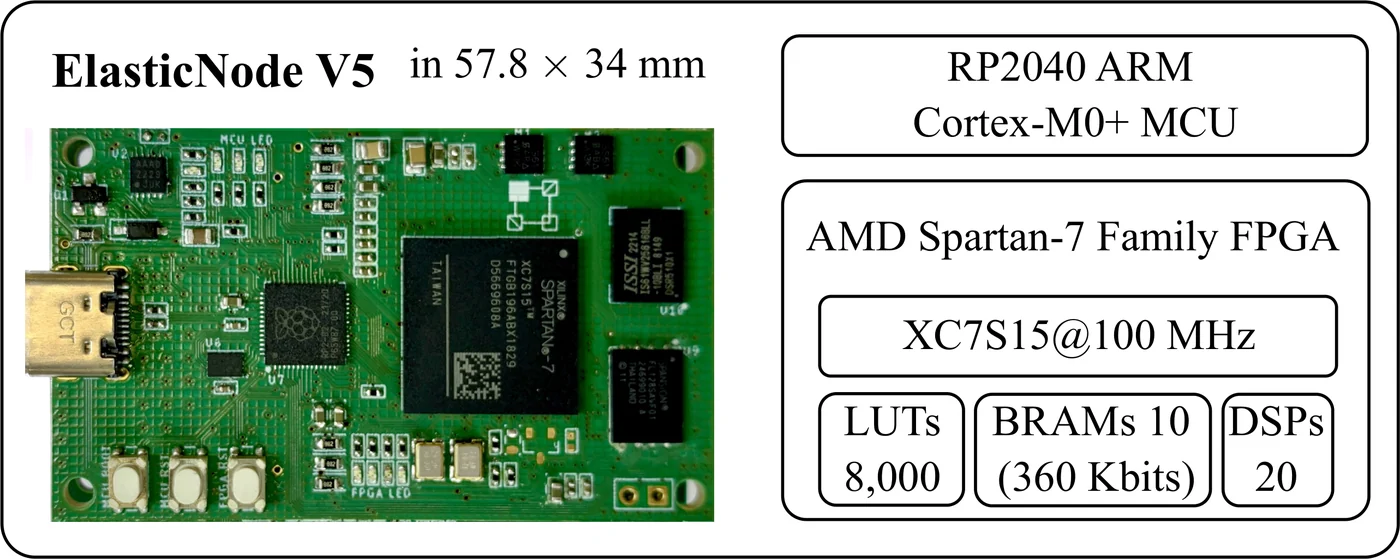
The ElasticNode V5 board with an AMD Spartan-7 FPGA, which runs the forecasting models at the edge.
ConferenceIEEE ISC2 2025
Automated Energy-Aware Time-Series Model Deployment on Embedded FPGAs for Resilient Combined Sewer Overflow Management
Tianheng Ling*, Vipin Singh*, Chao Qian, Felix Bießmann, Gregor Schiele
Deploys time series models on resource-constrained edge devices for combined sewer monitoring, with an automated hardware-aware pipeline that optimizes model configurations for energy consumption and predictive performance.
@inproceedings{ling2025fpga,
  author        = {Ling, Tianheng and Singh, Vipin and Qian, Chao and Bie{\ss}mann, Felix and Schiele, Gregor},
  title         = {{Automated Energy-Aware Time-Series Model Deployment on Embedded FPGAs for Resilient Combined Sewer Overflow Management}},
  booktitle     = {2025 IEEE International Smart Cities Conference (ISC2)},
  pages         = {1--6},
  address       = {Patras, Greece},
  publisher     = {IEEE},
  year          = {2025},
  month         = oct,
  doi           = {10.1109/ISC266238.2025.11293267},
  eprint        = {2508.13905},
  archivePrefix = {arXiv}
}
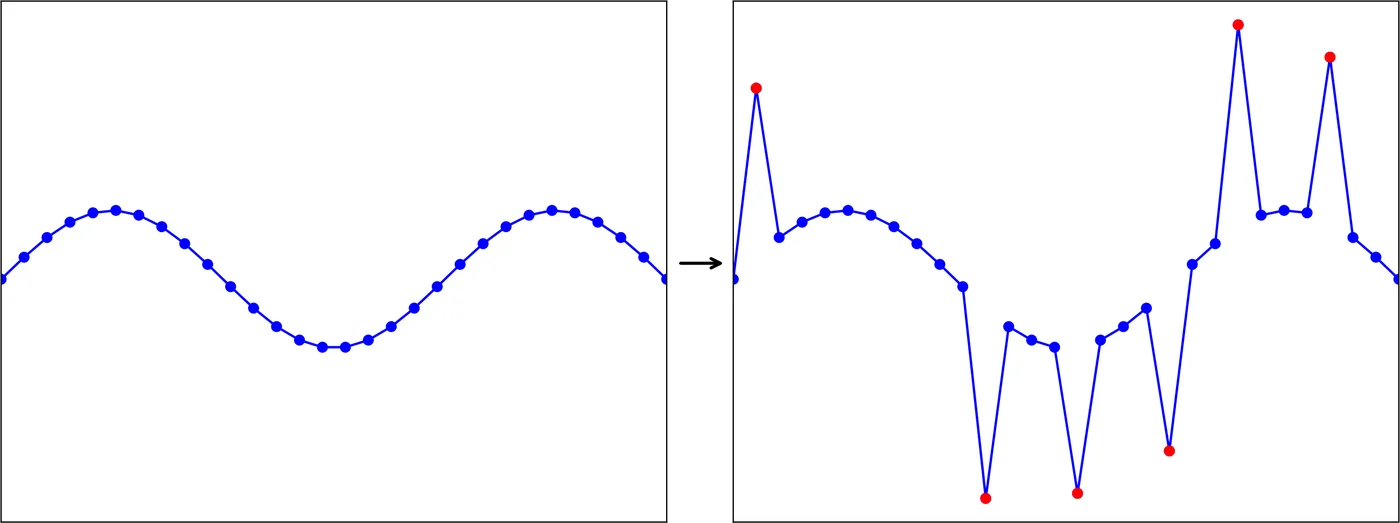
One of the perturbations used to test robustness: a clean sensor signal (left) corrupted with outliers (right).
ConferenceSpliTech 2025
Evaluating Time Series Models for Urban Wastewater Management: Predictive Performance, Model Complexity and Resilience
Vipin Singh, Tianheng Ling, Teodor Chiaburu, Felix Bießmann
2025 10th International Conference on Smart and Sustainable Technologies (SpliTech), Bol and Split, Croatia, 2025.
A protocol for evaluating neural forecasting architectures for combined sewer systems on predictive performance, model complexity and robustness to data perturbations, including peak events and a comparison of global and local modeling paradigms.
@inproceedings{singh2025timeseries,
  author        = {Singh, Vipin and Ling, Tianheng and Chiaburu, Teodor and Bie{\ss}mann, Felix},
  title         = {{Evaluating Time Series Models for Urban Wastewater Management: Predictive Performance, Model Complexity and Resilience}},
  booktitle     = {2025 10th International Conference on Smart and Sustainable Technologies ({SpliTech})},
  pages         = {1--6},
  address       = {Bol and Split, Croatia},
  publisher     = {IEEE},
  year          = {2025},
  month         = jun,
  doi           = {10.23919/SpliTech65624.2025.11091801},
  eprint        = {2504.17461},
  archivePrefix = {arXiv}
}
2024
A combined sewer system: during heavy rain, rain basins can overflow into surface waters.
WorkshopKI 2024 Workshop
Data-driven Modeling of Combined Sewer Systems for Urban Sustainability: An Empirical Evaluation
Vipin Singh, Tianheng Ling, Teodor Chiaburu, Felix Bießmann
2nd Workshop on Public Interest AI at the 47th German Conference on AI (KI 2024), CEUR Workshop Proceedings 3958, Würzburg, Germany, 2024.
Compares neural time series models for forecasting rain basin filling levels during network outages, contrasting global models with access to all sensors against local models restricted to nearby sensors.
 Cognitive Algorithms Lab